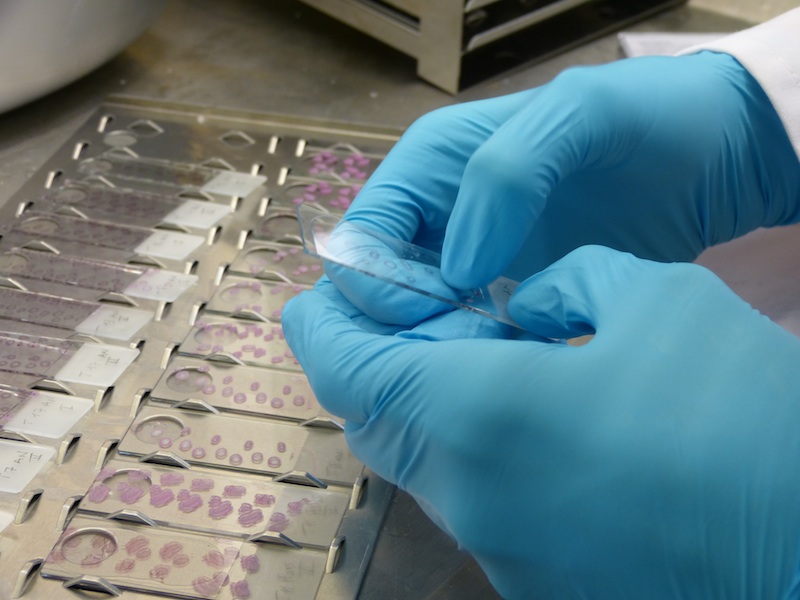
Prospective students might not be very familiar with the degrees that we
offer in Healthcare Sciences and this post is designed to give a bit of
background information away from the formal descriptions on the Plymouth University website.
The accredited Healthcare Sciences degree that we run is split into two
disciplines, Life Sciences and Physiology, that are very similar
to degrees offered by other institutions in Clinical Laboratory Science and
Clinical Physiology. These programmes are designed to train students to
work within professional healthcare. Follow the links above for information on applying to study etc.
Physiology incorporates specialisms in
cardiovascular, respiratory and sleep science (CVRS) and the Life Sciences program allows
students to specialise in Blood
(Haematology), Cellular (Pathology) or Infection (Microbiology and Immunology)
Science.
 |
| Official placement tunic for Physiology |
Physiology incorporates
core training (1st year) in the scientific basis of healthcare,
human physiology and pathophysiology, pharmacology and therapeutics,
cardiovascular and respiratory physiology. Students will then specialise in
years 2 and 3 within one pathway chosen from either Cardiovascular
Physiology (cardiovascular physiology in health and disease) or
Respiratory and Sleep Science (respiratory and sleep science in health and
disease). Additional modules include components in practice and work
based learning in healthcare, clinical physiology, instrumentation and
techniques, disorders, methods in diagnosis and monitoring, evidence based
practice in healthcare including advanced investigations.
Life Sciences incorporates
core training (1st year) in the foundations of healthcare science
practice, biomolecular science, cellular and molecular biomedicine and
pharmacology and therapeutics. Students
will then specialise in years 2 and 3 within one pathway chosen from: Blood (blood
science in health and disease), Cellular (cellular science in health and
disease), or Infection Science (Infection Sciences in health and
disease). Additional modules include diagnostic and clinical biomedicine,
techniques in microscopy and molecular biology, evidence based practice in
healthcare including advanced investigations.
One
of the really key and attractive aspects of these courses are the
work placements. These form an integral part of the course. Over the
three
years of the degree, you will get almost a whole year of placement in a
clinical lab (or labs) or department in the NHS meaning that you are
getting highly
relevant work experience. Our first cohort of students is on placement
at the moment and they seem to be learning a huge amount and enjoying
it. The
placements are split over the three years as detailed below:
In order to fit the placements into the academic year, they are held
(partly) over the summer so the course requires you to work for some of the
time during the normal university holiday period (in much the same way as
nursing, midwifery or medical degrees).
When you graduate, you will be a qualified
Healthcare Science Practitioner and therefore qualify for direct entry into NHS employment in their
specialised field. For instance, you could go on to work in a cardiology
department (Physiology) or a Microbiology or Histopathology lab (Life Sciences).
Graduates will qualify for direct entry onto the highly desirable Scientific
Training Programme (STP). Graduates will also be highly desirable for employment
in the private sector within pharmaceutical and healthcare industries due to the
practical skills gained during their placements.
Student comments 2012
‘This
degree program is not only intellectually stimulating but it allows
opportunities of real life clinical exposure and provides a lot of patient
interaction. This allows me to combine my social skills with my love of
science’
Ali Wong, BSc Healthcare Science (Physiological Sciences).
‘The
interaction between academic learning and clinical exposure has created a more
dynamic and challenging learning environment’
Jamie Walton, BSc Healthcare Science (Physiological Sciences)
“Studying
this course provides an invaluable insight into the vital science that
underpins medicine. Clinical placements provide a unique opportunity to see and
run diagnostic tests, as-well as providing us with the opportunity to make life
long contacts within the field of healthcare and biomedical sciences”.
Neil Marshall, BSc Healthcare Science (Life Sciences)
Additional information
The degrees are accredited by Medical Education England and the National
Academy of Healthcare Sciences allowing graduates to be able to apply to be
registered by an appropriate professional body for their chosen career path.